You start your car and notice a symbol shaped like a tire with an exclamation mark in the middle.
That is your Tire Pressure Monitoring System, commonly called TPMS.
The system is designed to warn you when one or more tires becomes significantly underinflated. If the TPMS light comes on, it should not simply be ignored until your next service appointment.
What Does a Solid TPMS Light Mean?
When the tire pressure warning stays illuminated, at least one tire may be significantly underinflated.
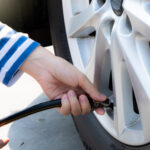
The first step is to inspect the tires and check their pressure with an accurate gauge. NHTSA recommends checking tire pressure regularly because underinflation can be difficult to identify just by looking at a tire.
Your correct PSI is based on the vehicle manufacturer’s specification, which is normally located on the driver’s-side door placard or in the owner’s manual—not simply on the number molded into the tire sidewall.
Why Does My TPMS Light Come On and Then Turn Off?
Sometimes the light appears during a cold morning and disappears after you have been driving.
NHTSA explains that marginally low tire pressure can fall below the TPMS warning threshold as temperatures drop. As the tires warm during operation, pressure can increase enough for the warning to disappear.
Even when that happens, the tire pressure should still be checked.
What If the TPMS Light Flashes?
A flashing light can mean something different.
On vehicles equipped under modern TPMS requirements, a warning that flashes for roughly 60 to 90 seconds and then remains illuminated can indicate a malfunction in the monitoring system rather than simply low tire pressure.
A malfunction can involve a TPMS sensor or another component of the system and should be professionally inspected.
Could You Have a Leak?
Low pressure does not always mean someone simply forgot to add air.
A tire can lose pressure because of a puncture, valve issue or another source of air loss. If you repeatedly add air to the same tire and the warning returns, the important question becomes why the tire is losing pressure.
That is where a professional tire inspection becomes more valuable than repeatedly resetting the pressure.
TPMS Does Not Replace Regular Tire Checks
One common mistake is assuming that no TPMS warning means every tire has perfect pressure.
NHTSA specifically notes that TPMS is not intended to replace regular tire maintenance and recommends checking tires with an accurate gauge on a monthly basis.
Think of TPMS as a warning system—not a substitute for tire inspection.
TPMS Inspection in El Paso
If your tire pressure light keeps coming back, flashes when you start the vehicle, or you are unsure whether a tire is losing air, La Tachuela offers TPMS inspections as part of its vehicle maintenance services.
Getting the system and tires checked can help identify whether the problem is simply inflation pressure, a damaged tire or an issue with the TPMS itself.
Visit La Tachuela in El Paso for a professional tire and TPMS inspection before a small warning becomes a bigger inconvenience.